Insurers’ Day 2026: Insurability begins with trust
A buried mountain village, mental health, cyberattacks, and fundamental philosophical questions: at
first glance, these topics have little in common. At Insurers’ Day 2026, however, they were linked by a central insight: they reveal how important robust insurance solutions are for the economy and society.
Summer and plenty of sunshine over St. Gallen. Anyone who had hoped to find slightly cooler temperatures
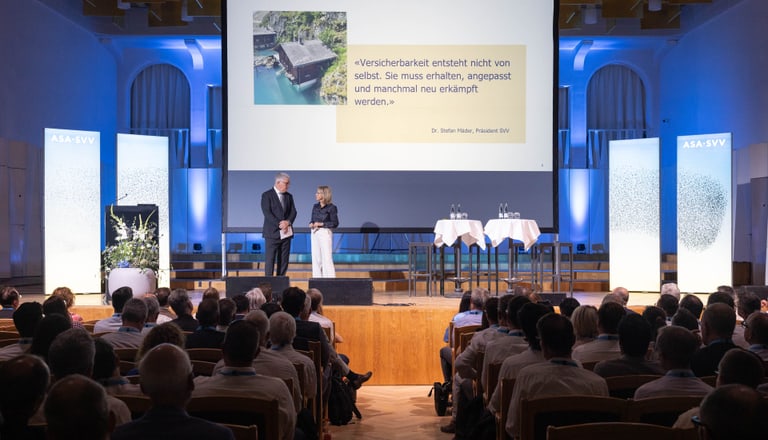
at just under 700 metres above sea level was disappointed. “Many thought it would be a bit cooler here – which it isn’t,” said SVV President Stefan Mäder right at the beginning with a smile. But on this summer day, it wasn’t only the weather that sparked conversation. Around 250 representatives of the Swiss insurance industry, along with guests from politics, public administration and business, discussed at the Tonhalle St. Gallen how “insurability” can be ensured in the future as well. Under the motto “Shaping insurability: for a strong economy and a resilient society,” the Swiss Insurance Association (SVV) put a topic at the centre of this year’s Insurers’ Day that reaches far beyond the industry itself.
Insurability is not a given
The content-focused opening was delivered by SVV President Stefan
Mäder, 2c765b0d" data-entity-substitution="canonical">who had previously been re-elected for another three-year term. Insurability, he said—his central message—does not come about by itself. “It must be preserved, adapted and sometimes even fought for anew.” As examples, he cited the challenges posed by natural hazards, cyber risks and geopolitical uncertainties. At the same time, reliable political and regulatory framework conditions are needed so that the insurance industry can continue to fulfil its economic function in the future.
Further perspectives on the future of insurability were provided by Stefan Walter, Director of the
Swiss Financial Market Supervisory Authority Finma, as well as Sandra Känzig, CISO of the Helvetia Baloise Group, and Sandro Nafzger, CEO of the IT security company Bug Bounty Switzerland. At the heart of their remarks were the current challenges facing the insurance industry—from regulatory issues and climate risks to the growing threat of cyberattacks.
Being able to deal with what cannot be controlled
The most thought-provoking contribution
of the day came from the philosopher Barbara Bleisch. She distinguished between dangers and risks and reminded us that modern societies are increasingly turning dangers into calculable risks—and in doing so, they simultaneously raise expectations of safety. “The desire for control is growing, while the willingness to endure uncertainty is dwindling.” Bleisch warned against reflexively looking for someone to blame behind every misfortune. “No matter how much we insure ourselves and take precautions—fate will never fall completely silent,” she said. A society’s resilience therefore also includes the ability to deal with what cannot be controlled and to endure uncertainty. “Not everything can be prevented, not every danger can be fully controlled.”
40 seconds between paradise and ruin
The most striking moment of the day belonged to Matthias
Bellwald, the mayor of Blatten. As he addressed his first sentences to the attentive audience, that mobile phone clip that went around the world at the end of May 2025 was playing in the background: the few seconds in which the mountain breaks away and the village in the Lötschental disappears beneath a massive cloud of dust and debris. Many in the hall knew the images. They had lost none of their force. “When it takes only 40 seconds to destroy a village community, bury traditions, and wipe out what people hold dear, it leaves deep scars,” said Bellwald.
His presentation, however, was not a look back at the disaster, but above all a look ahead. He described
how the people of Blatten developed new perspectives after losing their homes and possessions. Crucial, he said, were not only financial resources or new infrastructure. Just as important were trust, solidarity, and shared goals. “Building infrastructure is easy,” Bellwald emphasized. “Keeping a community together—that is the real challenge.” Particularly striking were his accounts of social cohesion. The village band was rehearsing again just a few weeks after the disaster with new instruments and has since become Swiss champion. The traditional Herrgottsgrenadiere procured new uniforms so that Corpus Christi could be celebrated again. The social fabric, Bellwald said, had remained intact despite everything. “Where there’s a will, there’s a way.”
With the “Vision Blatten 203
0,” the municipality is currently working intensively on reconstruction. Over 1,700 ideas from residents were incorporated into the planning of a new village. The aim is to create a mountain village with Alpine charm, sustainable tourism, modern infrastructure, and strong roots in the traditions of the Lötschental.
When the mind suffers
Another key topic was the mental health of young people
. Under the title “When the mind suffers—between personal responsibility and collective protection,” philosopher Barbara Bleisch, AXA Switzerland CEO Patric Deflorin, child and adolescent psychiatrist Axel Ladner, and Pax commercial apprentice Serena Stellavato discussed the causes and consequences of increasing psychological strain. The figures presented gave pause for thought. According to the ="https://www.axa.ch/de/ueber-axa/medien/medienmitteilungen/aktuelle-medienmitteilungen/2026/20260603-mind-health-report.html">current AXA Mind Health Report, 40 percent of 18- to 24-year-olds in Switzerland are struggling with mental health problems. Many respondents cited increased screen time on social media as a major influencing factor. Child and adolescent psychiatrist Axel Ladner reported enormous pressure for appointments at his practice. Anxiety disorders, concentration problems, and other psychological stresses have increased significantly in recent years.
Despite the seriousness of the topic, the discussion did not lack hope. This was embodied above all
by Serena Stellavato. The 19-year-old commercial trainee, who had taken her final apprenticeship exam just a few days earlier, authentically brought her generation’s perspective into the discussion. Young people would indeed talk about mental strain, she said—provided they had people they could trust. And when the group later spontaneously switched from the formal “Sie” to the informal “Du”, because young people, according to the trainee, feel more comfortable with it, it became clear that even small gestures can change an exchange.
Responsibility also requires personal responsibility
In closing, SVV CEO Urs Arbter picked up the thread once more. Insurability requires suitable
framework conditions, he said. “It doesn’t arise everywhere on its own, but often only through smart regulation and the interaction of the state, the economy and society.” At the same time, he warned against overregulation. “Not every challenge has to be answered with new rules.” Insurability also requires personal responsibility and room for entrepreneurial manoeuvre.
After the official part
, the exchange within the insurance community moved to the foyer and the terrace of the Tonhalle. Over a standing lunch, the discussion, debate and networking continued. The day had undoubtedly provided more than enough food for thought.
Note
The next Insurers’ Day will take place on 25 June 2027 in Bern.
.jpg)