
2025 BAK study: insurers are anchors of stability for the financial sector
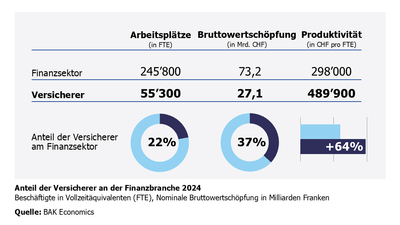
The financial sector remained one of the most important pillars of the Swiss economy in 2024. The study by BAK Economics shows that gross value added of CHF 73.2 billion was generated along the entire value chain of insurers and banks. Insurance services accounted for around 43 per cent of this figure. With CHF 489,900 in value added per full-time job, insurance was once again the most productive industry in the financial sector.
In 2024, the 245,800 employees of insurers and banks generated gross value added of CHF 73.2 billion. This means that the financial sector directly accounted for 5.5 per cent of jobs in Switzerland. The share of total gross value added is significantly higher, at 8.8 per cent – proof of the exceptionally high level of productivity in the sector. The insurance industry is particularly noteworthy: at CHF 489,900 per full-time position, it is almost 2.6 times as productive as the average for the economy as a whole. The productivity of insurance companies is not only above average, but also showed the strongest growth in the period under review.
With gross value added of CHF 31.4 billion, insurance services account for around 43 per cent of the financial sector. The majority of this is directly attributable to insurers, while a small proportion is also attributable to insurance-related financial services. In the insurance industry, property and casualty insurance is the largest segment in terms of gross value added. ‘The insurance industry has continued to grow steadily over the past 20 years without any major fluctuations, making it an anchor of stability for the Swiss economy,’ said Jan Schüpbach, Chief Economist at the Swiss Insurance Association (SIA).
Changes to the calculation methods
Gross value added measures the economic added value of a sector by subtracting external intermediate consumption from production value. As part of the revision of the Swiss National Accounts conducted in 2025, the value added in the financial sector was estimated to be lower on a retroactive basis. Reasons include new considerations regarding fund costs, a more precise delineation of foreign branches and adjustments to reinsurance. Due to these changes, a comparison with the previous year’s figures is only possible to a limited extent.
Insurance companies create jobs and generate tax revenue
The number of jobs in the financial sector has increased moderately over the past 20 years. A positive trend has been observed in the insurance industry since 2019, with a steady increase in jobs. In terms of the number of jobs, Zurich is Switzerland’s largest financial centre, followed by Geneva. The BAK study also identifies four cantons – Lucerne, Basel-Stadt, Vaud and Bern – in which insurers account for more jobs than banks or other financial service providers.
The financial sector is also an important source of income for the public sector. Through direct taxation of income and profits, the federal administration, cantons and municipalities generated a tax revenue of CHF 9.9 billion in 2024 – this corresponds to over 9 per cent of tax revenue from the taxation of individuals and legal entities.
A driving force for other industries
The financial sector not only creates direct value added, but also acts as a driver for other industries. Insurers and banks generate additional orders along the entire upstream value chain through their demand for intermediate goods and services, such as IT and consulting services. Trade and commerce also benefit from the consumer spending of employees in the financial sector.
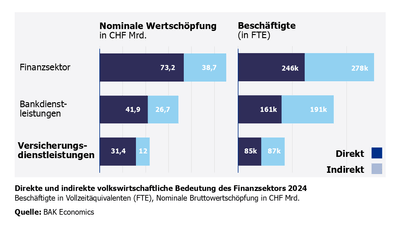
As a result of these multiplier effects, the financial sector generated additional gross value added of CHF 38.7 billion in 2024. In total, CHF 111.9 billion – or more than one in seven francs of value added – was attributable to the activities of the financial sector.
The same applies to the labour market. On average, one additional job was created in other industries for every job in the financial sector. In total, 523,700 jobs are directly or indirectly related to the activities of the financial sector. Discussing the results of the study, Martin Hess, Head of Economic Policy at the Swiss Bankers Association, said: ‘The study clearly shows that the financial sector does far more than is often perceived. Banks create stable value added, secure jobs and, thanks to favourable financing conditions, enable investment across the entire Swiss economy.’
Dynamic outlook for the Swiss financial sector
Despite geopolitical uncertainties, the stock market performed well in 2025, offering prospects for growth. Although BAK Economics is forecasting moderate overall economic growth of 1.1 per cent for Switzerland, demand for labour is expected to remain high, which would lead to a slight increase in employment (FTE) of 0.4 per cent in 2025.
For the insurance industry, BAK Economics is forecasting growth of 1.8 per cent for 2025, which would be above the overall economic average. This is despite the fact that insurers experienced an above-average claim burden in 2025. In the medium term, insurers are expected to benefit from the stronger economy and general economic and population growth. BAK Economics expects real gross value added to grow by 2.1 per cent in 2026 and anticipates average growth of 2.5 per cent for 2027–2030. With robust, above-average employment growth, insurers are likely to create additional jobs in the coming years.
About the study
The study on the economic importance of the Swiss financial sector, compiled by BAK Economics, is published once a year. It is commissioned by the Swiss Insurance Association (SIA) and the Swiss Bankers Association (SBA). The focus is on the most important key figures for the financial sector, such as value added, jobs and tax revenue.
You can find the studies from 2024, 2023, 2022 and 2021 here.
You may also be interested
- Study | 28 November 2024
BAK Study 2024: insurers remain the most productive sector in the financial indu
The BAK study shows that private insurance was still one of the most productive and economically important sectors in Switzerland in 2023.

- Study | 23 November 2023
Economic significance of the Swiss financial sector - Figures 2023
The study conducted by BAK Economics on the economic importance of the financial sector shows that insurers will continue to be one of the most productive sectors of the Swiss economy in 2022.

- Study | 22 November 2022
BAK Study 2022: Economic importance of the Swiss financial sector
The study conducted by BAK Economics shows that the financial sector remains one of the most productive industries in the Swiss economy in 2021.

- Study | 23 November 2021
Economic Impact of the Swiss Financial Sector – Figures 2021
Study commissioned by the Swiss Insurance Association (SIA) and the Swiss Bankers Association (SBA).
Figures for 2021.